
Search for “kajkavski” on Google today. Look to the right side of the results. What you see is a Knowledge Panel – Google’s algorithmically generated summary of what an entity is, drawn from the most authoritative sources available.
And there it is: Kajkavian (Kajkavisch) – Spoken language.
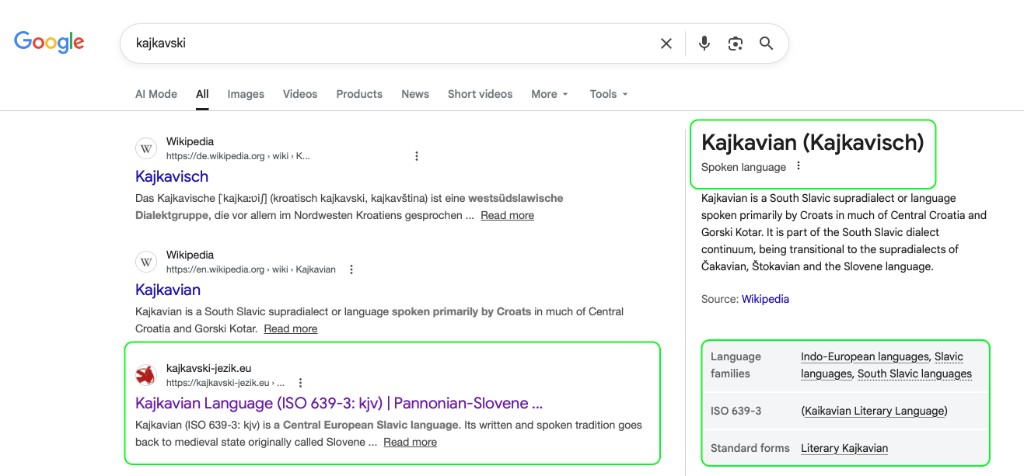
It’s not a dialect, not a sub-variant, not a regional curiosity. It is a Language – with its own entry, its own classification, its own standing in the world’s linguistic taxonomy. This is not an opinion piece by a sympathetic journalist. This is Google’s own knowledge graph, assembled from Wikidata, Wikipedia, and peer-reviewed linguistic databases, presenting Kajkavian exactly as it should have been presented all along.
Four facts that changed everything
The Knowledge Panel displays four key pieces of information. Each one represents a battle that was fought – and won.
1. “Spoken language” – not “dialect”
For decades, Croatian institutional linguistics classified Kajkavian as a “dialect of Croatian” – a subordinate variety, not worthy of its own identity. Google’s Knowledge Panel contradicts this directly. Kajkavian is listed as a spoken language, placed alongside other recognized languages of the world. The classification is not arbitrary – it reflects the consensus of international linguistic databases.
2. Language families: Indo-European, Slavic, South Slavic
Kajkavian is positioned correctly in the linguistic family tree – as its own branch within the South Slavic family. Not as a sub-dialect of a sub-dialect, but as a language in its own right, standing among its peers. This positioning reflects what comparative linguistics has always known: Kajkavian’s relationship to Slovene is closer than to Štokavian. It belongs to the Central European Slavic circle, not to the Balkanic south.
3. ISO 639-3: kjv – Kaikavian Literary Language
This is the foundation on which everything else stands. In early 2015, after a rigorous two-year application process with SIL International – the organization authorized by ISO to maintain the language code registry – Mario Jembrih from Kajkavska Renesansa created the request and obtained the international language code kjv for Kajkavian Literary Language.
An ISO 639-3 code is not a symbolic gesture. It is the international standard for identifying languages. It is used in software localization, library cataloguing, digital preservation, academic citation, and machine translation systems worldwide. When Kajkavian received kjv, it became visible – not just to linguists, but to every system on Earth that processes language data.
This code made the Wikipedia Kajkavian edition possible. It made the Wikidata classification possible. And it made this very Knowledge Panel possible.
4. Standard forms: Literary Kajkavian
The panel acknowledges what Kajkavian speakers have always known: this is not “just oral speech.” Kajkavian has a literary standard – a rich written tradition stretching from the 16th century to the 19th, with ongoing literary production to this day. Works in Kajkavian literary language are held in the national libraries of Vienna, Budapest, Ljubljana, and Zagreb. This literary heritage is the evidence that no institutional narrative can erase.
Wikipedia reflects the same framework
It is worth noting that Wikipedia’s article on Kajkavian now classifies it in line with the framework established through the ISO code process. The language family classification, the ISO code, the literary standard – these are not Wikipedia’s inventions. They are the result of the work done by Mario Jembrih to put Kajkavian on the world stage of languages, and Wikipedia now reflects this reality.
A milestone, not a finish line
This Knowledge Panel is a validation – an algorithmic, unbiased confirmation from the world’s largest information system that Kajkavian is a language. But it is not the end of the road.
Kajkavian still faces systematic marginalization from Croatian institutions. Its Slavic, Central European identity remains threatened by decades of institutional language policy that has pushed Kajkavian language to the margins in favor of Neostokavian dialect – yet the distinct Pannonian-Slovene identity persists.
The Knowledge Panel tells the world what we have always known. Now it is up to us – speakers, writers, teachers, and advocates – to make sure the world listens.
Use the language. Write in it. Demand its recognition. The world is already watching.