
The map shows area of Kajkavian language. It includes also mixed Kajkavian-Stokavian dialects mostly at the edges of the dark green area. Besides this, the map shows areas in Slovenia where dialects similar or closed to Kajkavians are spoken. They can be regarded as transitional dialects from Slovene to Kajkavian language, however, some of them are originally clearly more Kajkavian (e.g. Prekmurye dialect 80% Kajkavian, 20% Slovene acording to its lexis and other linguistic elements) Some of these areas have been within Zagreb diocese still in 18th century like Prekmurje or parts of Prlekija, and other belonged or gravitated to Kajkavian cultural circle. It means they used Kaikaivan books and /or attended Kajkavian (high)schools.
Thus these connections are also still evident in e.g. family names which are same on both Croatian and Slovene border.
Clicking on the map you get bigger picture.
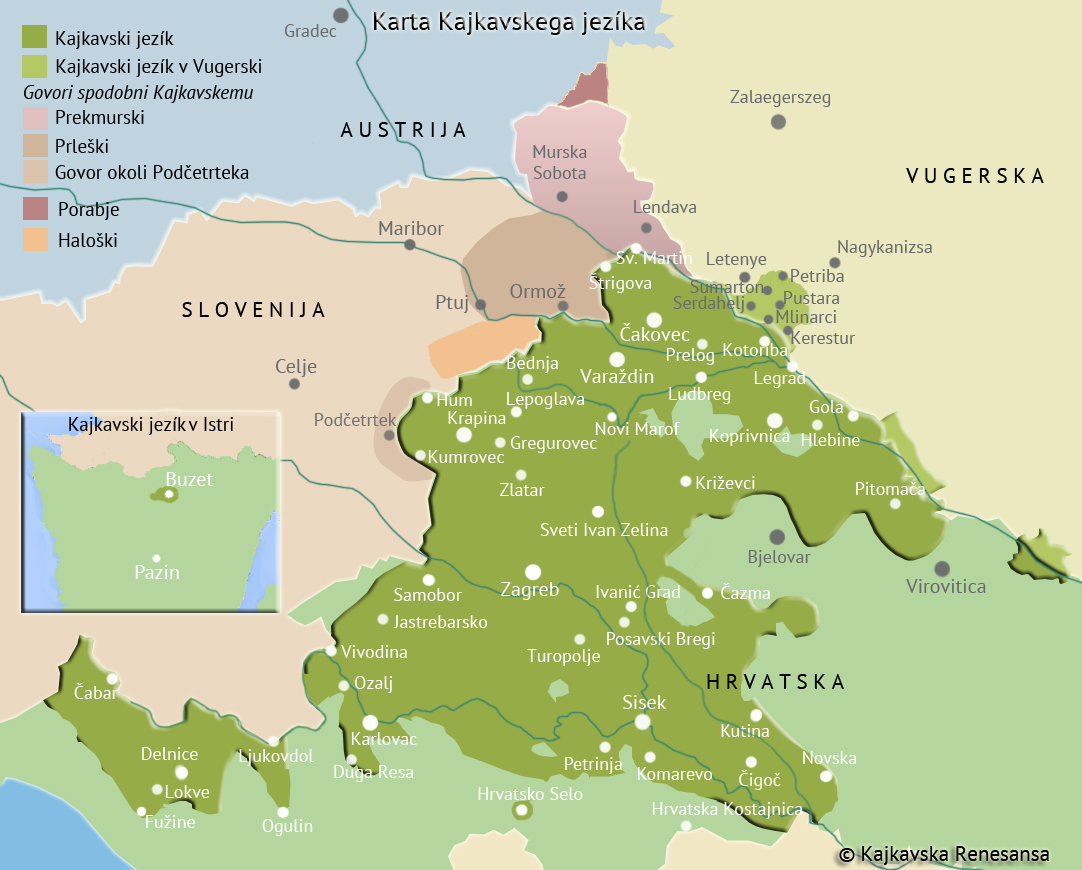
While the majority of Kajkavian dialects within the Kajkavian speaking region is known to public or they heard at least, the Kajkavian(transitional) dialects ar only known to some linguists. That is why we present them here for the 1st time to public.
DIALECTS SIMILAR TO KAIKAVIAN OUTSIDE OF KAIKAVIAN REGION
BUZET dialect:
Buzet dialect separated very early from other Kajkavian dialectbut it still kept some typical Kaikvian charcterstics. Since it is separated from the “mainland” of Kajkavian dialects, it can only have gotten its Kajkavian charactertics by being originally a Kajkavian dialect, which has taken over through centuries of language contact Chakavian and some Slovene elements.
The Buzet dialect differs in lexis and phonology from the most dialects in Istria and neighboring Slovenia (and is similar to older Kajkavian dijalects like Bednjanski).
Sources:
- Informations from the field from native speakers who both know Chakavian and Kajkavian tell us that Buzed dialect is similar to Kajkavian dialects, with Chakavian influence.
- Rac M., Lovrić A.Ž.: Naravoslovno nazivlje istarskih polukajkavaca oko Buzeta. Zbornik Tjedna kajkavske kulture knj. 2, Muži zagorskog srca, Zabok-Krapina, 2006.
- Kajkavian Dialect of Buzet (in Croatian)
PREKMURJE:
Prekmurye was till the end of 18th. ct. in Zagreb diocese, and developed within Kajkavian cultural circle. Original Prekmurye dialect shares characteristics of with Kaikaivan language more than with todays Slovene. Martjanska pesmarica from 16th century is the oldest Kajkavian handwritten book of folk-songs. (Ivan Zvonar 1998)
Sources:
- Ivan Zvonar: MOTIVSKO-TEMATSKI SVIJET U KUKULJEVIĆEVIM ZAPISIMA KAJKAVSKIH USMENIH PJESAMA, 1998, HAZU Varaždin
- Lončarić, Celinić: Susret slovenskih prekmurskih i hrvatskih međimurskih govora, Slavistična revija, 2007, št. 1-2
PORABJE:
Belongs to Prekmurye dialect with some special features. According to our comparation of words (and according to development of vowels see Lončarič, Celinič), Porabian words and exrepssions are a lot more similar to Kajkavian, mostly to dialect of Upper Megymorye.
- Source: Francek Mukič: PORABSKO-KNJIŽNOSLOVENSKO-MADŽARSKI SLOVAR, Sombatelj 2005.
PRLEKIJA:
Prlekija also developed withing Kajkavian cultural circleand was under heavy influence of Varaždin. Also one of the most famous Slovenian philologists, Franc Miklošič from vicinity of Ljutomer, attented the high-school of Varaždin.
- Source: Golec, Boris: “So bili štajerski Prleki v 18. stoletju Hrvatje in kakšno vlogo je imel pri tem Varaždin?”, Zbornik “800 godina slobodnog kraljevskog grada Varaždina 1209.-2009”, 2009.
PODČETRTEK:
As much as we could hear in the field, visiting Podčetrtek (Sveta Ema), their dialect (Kozjanski) has Kajkavian accentuation system and Kajkavian lexis.
If it belongs to Kajkavian language, needs to be explored in the future, but we keep it under dialects similar to Kajkavian. Also Kajkavians around Hum na Sutli – say that their Kajkavian dialect is mostly similar to “how Slovenes over the border speak“.
Source:
Listen for yourself: Ivan Žakar, 80% Kajkavian, around 20% Slovenian!
- Jembrih, Alojz: Obilježja dvaju govora uz rijeku Sutlu: Podčertka u Sloveniji i Razvora u Hrvatskoj, Časopis za kulturu “Hrvatsko Zagorje”, 2003.
HALOŠKI:
Dialect south of Ptuj. Similar to Prekmurye and Porabye dialect, different from majority of Slovenian dialects. Also similar development like dialects of Kajkavian language.
- Lundberg, Grant H.: Typology of Tone Loss in Haloze, Slovenia: An Acoustic and Autosegmental Analysis, 2001